
I have been writing seriously for about seven years now. By seriously, I just mean writing with a mind for art-making and audience gathering and eventually publication. I have engaged myself primarily upon *phantastical* (read: fantasy x sci-fi x horror) short fiction and loquacious essays about my favorite books, movies, animanga, and more. I have written self-diaries and social critiques and sh*tposts galore. Now that I am writing novels, with clear conviction and a crystallized process to the whole act, I figure I should try to levy some writing advice to others (and myself, for future referencing).
My creative writing advice comes as a multi-part answer to the simple question:
How do you write well?
Here are some of the things I have learned from my writing journey.
Note: Some of my writing – and other content – can be viewed on Twitter/X:
https://x.com/finalboyo/status/1840806403897745476
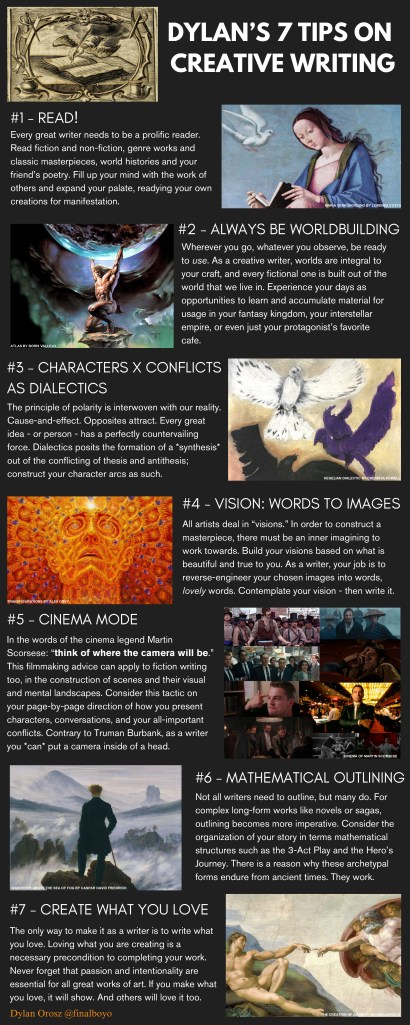
#1 – Read!

Aspiring to write well means knowing how to read well.
By *read* I mean make a practice of it; go out of your way to read books, articles, essays, poetry, and more books. What reading does for me is fill up the chamber. Words and characters and stories light up my unconscious mind with the material I need to start crafting my own stories.
The concept of “reading” applies just as equally to movies and documentaries and music too, given that a writer’s knowledge must be all-encompassing. Every artist needs to carve out a sense of what they like, what they hate ~ and what they love. This is called *taste* and there is no one way to do it.
Every writer has a different taste. And this is integral to your power as a creator.
I believe reading is the key to writing because reading ultimately makes you smarter, i.e. better able to communicate and think. Needless to say, better thinking leads to better writing.
#2 – Always Be Worldbuilding

As a writer, you need to carry around your brain like an open briefcase.
Everywhere you go, even without realizing it, you are accumulating valuable experience, storing prospective material. This may sound trite, but as a working writer I believe you never really go off the clock. What you observe in the world around you is the beginnings of the worlds within you.
Let me take a step back and say that “worldbuilding” is not just the duty of the fantasy author and the sci-fi nerd. Every story has worldbuilding; while it may not be a castle or a starship or a form of magic, your literary novel’s cafe as the final locale where your climax plays out must be well-defined as part of your world. You must imagine your cafes, with their flavors and baristas and patrons, just in the same way as you imagine your variation on the origin of the dragon.
Wherever you go, whatever you see and hear — it all becomes part of your inner repertoire. Studying the cycles of history can also go a long way in this regard. (Just be sure to take notes!)
#3 – Characters x Conflicts as Dialectics

One of the seven Hermetic Principles is known as Polarity.
It means that everything is dual; every action has a reaction, every thesis its antithesis, every person a potential nemesis. You get the picture.
Dialectics is the expansive study of a simple and related process: Thesis > Antithesis ∴ *Synthesis*
I like to apply this perspective to the characters I create and the conflicts they manage to stir up between themselves. Read any great fairy tale or religious text, or spend some time exploring the crime genre, and you start to see this used everywhere. Good vs. evil, angels vs. demons, lawmen vs. outlaws.
All great conflicts have this duality, of equally powerful and therefore compelling forces. People are checked by, or attracted to, their polar opposites.
In my view, great character arcs are marked by a dialectic of change driven by other characters which represent opposing energy ~ sometimes as friends and often as foes.
#4 – Vision: Words to Images

My primary breakthrough as a long-form writer comes with this concept of *Vision.*
It was not until I had a vision for what I wanted to do with a given work that I could amply proceed with the writing. By vision, I mean just that ~ a clear image in my head for the flow of the story and its most exciting images. Your job as a writer ultimately becomes to reverse-engineer those finale images back into words ~ lovely words.
Turning words into images is no easy task, and it requires the alchemy of pervasive life and writing experience.
In order to reach the stage of even peeking the imagery that you want to create on the page, you must read other great stories and engage in real-life experiences. Such things expand your imagination and open your mind unlike anything else. You must also write a lot, with a mind for exercises and practice before true “art” can be produced. (Or, at least, art that you will want to call your own.)
You will eventually reach a point where you carry a truly artistic worldview. You will see the truth of effective character dynamics, your sense of pacing will fall into place, and you’ll be illuminated by the underlying ideals and philosophies and human flaws that make up great stories. Your perspective does not have to be “right” or set in stone. But you do need a clear view of narrative theory and an inner imaginatrix to start seeing your own story visions. From there, you will be motivated to bring your chosen images and words to life through art.
My own process involved much writing practice, on small ideas, and on others’ ideas, in order to reach the point where I started to wield visions myself, for unique and original storytelling within worlds of my own.
Visioneering is an art and only for the boldest of characters. I believe artists see visions as revelation.
#5 – Cinema Mode: think of where the camera will be

If the last tip “Vision” is more of a grand strategic mindset, the macrocosm of the writing process — think of this one like a microcosm, a simple yet effective tactic on the page-by-page and for constructing your scenes.
I learned this from Martin Scorsese, one of cinema’s greatest legends, in his advice to young filmmakers about how to generate effective camera shots in the ultimate audiovisual storytelling medium.
“Think of where the camera will be.” For a filmmaker, this perspective is obvious yet constantly necessary, therefore making the concept ingenious. There are practically innumerable ways to shoot any given scene, even if it’s just a diner conversation or a short montage on the beach.
Where is the camera? What can we see?
Apply the same thing to writing — think of where the camera is in your scene. What do you want your readers to see? (This can be visual landscapes or mental ones.) In what order will the major descriptions, dialogues, and dynamic actions be done? Where is the light coming from?
Punctuation, from periods to commas to semicolons, can be used to effectively *shift* the camera around, going between the characters and realizations of your unfolding story. Meditate on this; experiment with such linguistic cinematography in your next story.
#6 – Outlining: *math* out where you want your story to go

My advice on outlining pairs with the concept of “Vision” and was another major breakthrough for me in the writing process for my novels.
I won’t tell you that every writer needs to outline. That is not true and some discovery writers or “pantsers” can do it all on the go, improvising their stories to great effect. But I would argue that many writers do need to outline, and I am certainly one of them. Generally speaking, the more complex your work is the more likely you will need to outline it.
I’ve always been a bit of a hybrid in my short fiction, in terms of outlining vs. discovery; I am something of a plantser if you will. Many times my outline would consist of a single line like “A scientist gains the ability to send his consciousness backward in time” and then I would start writing that story without any idea for where it goes or how it ends. In the work of drafting, I would discover that, naturally, the scientist wants to go back to ancient Jerusalem and enter the mind of Jesus Christ, impacting all future events with his actions therein…
But I think that is part of my philosophy on short fiction — I like to be surprised most of all.
On novel writing, I needed more of a plan. Here, I mean a chapter-by-chapter outline, with every character personified and the major elements of the world hashed out. I needed that all-important “Vision” of what my story is and how it was going to tell itself, within the boundaries of my worldbuilding and cast. I also needed to completely plan out specific scenes and locales, battle sequences and majestic revelations — character outcomes and satisfying resolutions.
Knowing all this in advance is vital to my long-form writing process. For me to embark on the long, sometimes painful, sometimes pleasurable journey of writing a book, I need to have the chapter-by-chapter mathed out, at least at a conceptual level and sometimes with specific dialogue already pitched.
I say “math out” not just as an expression, but to mean that there is a level of math to a great story. Symmetry and logic are definite aspects of all beautiful art. Consider this in your writing, on the page-by-page and the macro level in terms of your story’s organization. This math aspect to storytelling is why the archetype of the Hero’s Journey is so popular — and why you are probably using pieces of it even without realizing. It just works.
#7 – Sublime Love: make sure to create something special to *you*

Writing is hard work. And we are now residing in a world where this kind of creativity is becoming less valued, at times oversaturated with low-rent junk, and even attacked by rogue psychic and technological forces. Hold fast. Stay strong. Remember why you are writing in the first place.
Everyone’s answer may be different. But I do believe there is a sublime commonality to our breed:
Writers write because they want to create stories that they love.
My final piece of advice is just as simple ~ write what you love.
If you do not, you may find the process lacking and lose motivation. I find that I cannot write any other way. If I do not love my story, I cannot complete it.
All great art must have the impassioned *intentionality* borne of a human soul. Never forget this.
Thank you for reading!
Godspeed,
Dylan

Imgur LINK

 Thresholds of Transformation