~ essay on Attack on Titan by Hajime Isayama.

I grew up being *attacked* by Attack on Titan. As a story, it is a profound emotional experience; as a production, on the black-and-white page or via the exquisite animation of Wit and MAPPA, acted wondrously by the full Japanese + English cast (including Hiroyuki Sawano’s godlike OST) — AoT is truly one of a kind. Unforgettable and undeniably great, to read the series is to take part in history. I believe Hajime Isayama penned a masterpiece not to be surpassed. I am hardly alone in this.
The anime, and later the manga, became something of an obsession for me personally. Few other story sagas have had as much of an impact on me for such a long period of time. So much so that I have avoided writing much about it, unsure of where or how to start. Completing yet another rewatch, the final one for a good while, I wanted to close the book with some scattering musings on the art and its thematic realities hopefully amounting to something called “essay.” SPOILERS AHEAD.
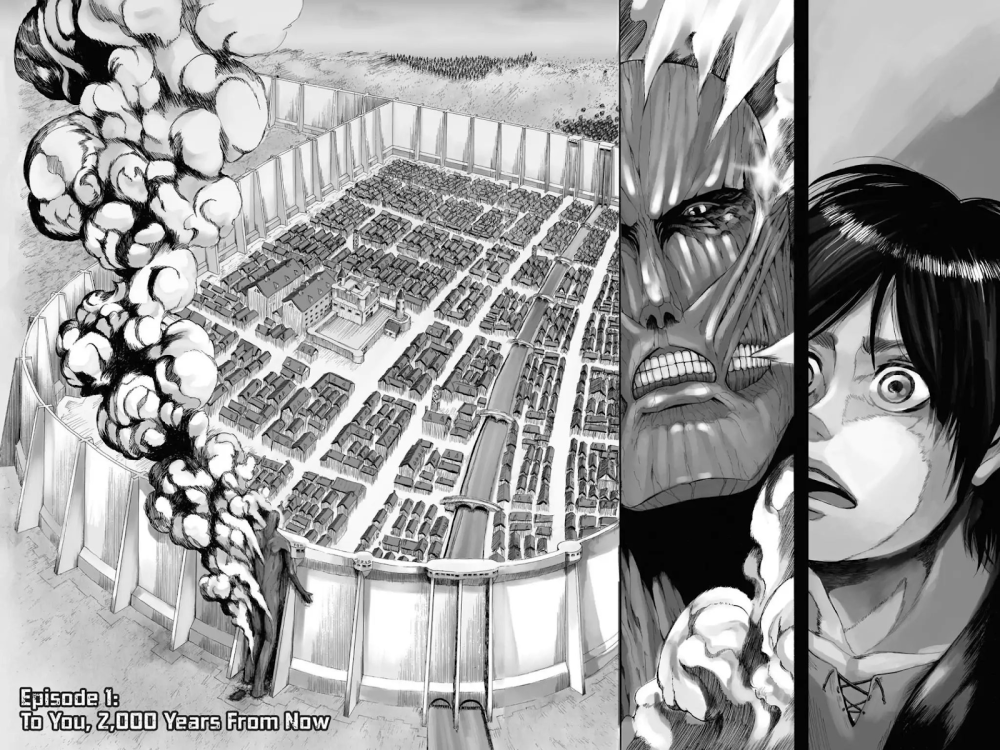
From 2009 to now, AoT by Isayama provided to the world thrills, mysteries, and revelations that few other creators could (or will) ever manage. Plot x Character x World-Build x Action x Love x Hate x Horror x Redemption x Betrayal x Strategy x Sacrifice x Meaning. AoT has it all in spades. Like some of my other favorite animanga stories (Berserk, Fullmetal Alchemist, Evangelion, Hunter x Hunter), it is an everything story; in AoT, a wide and dynamic cast of complex characters enact a story that takes shape over 2,000 years. Initially an action-fantasy-horror vehicle, Isayama’s story evolves as great stories do, soon encompassing a darkly philosophical battleground and a harrowing past x present x future embroiled in an existential conflict for the fate of humanity.
Few other series are willing to go as far and as hard as AoT did. Few other stories have I ever seen *transform* like this one.
Attack on Titan, at its heart, must be about transformation.

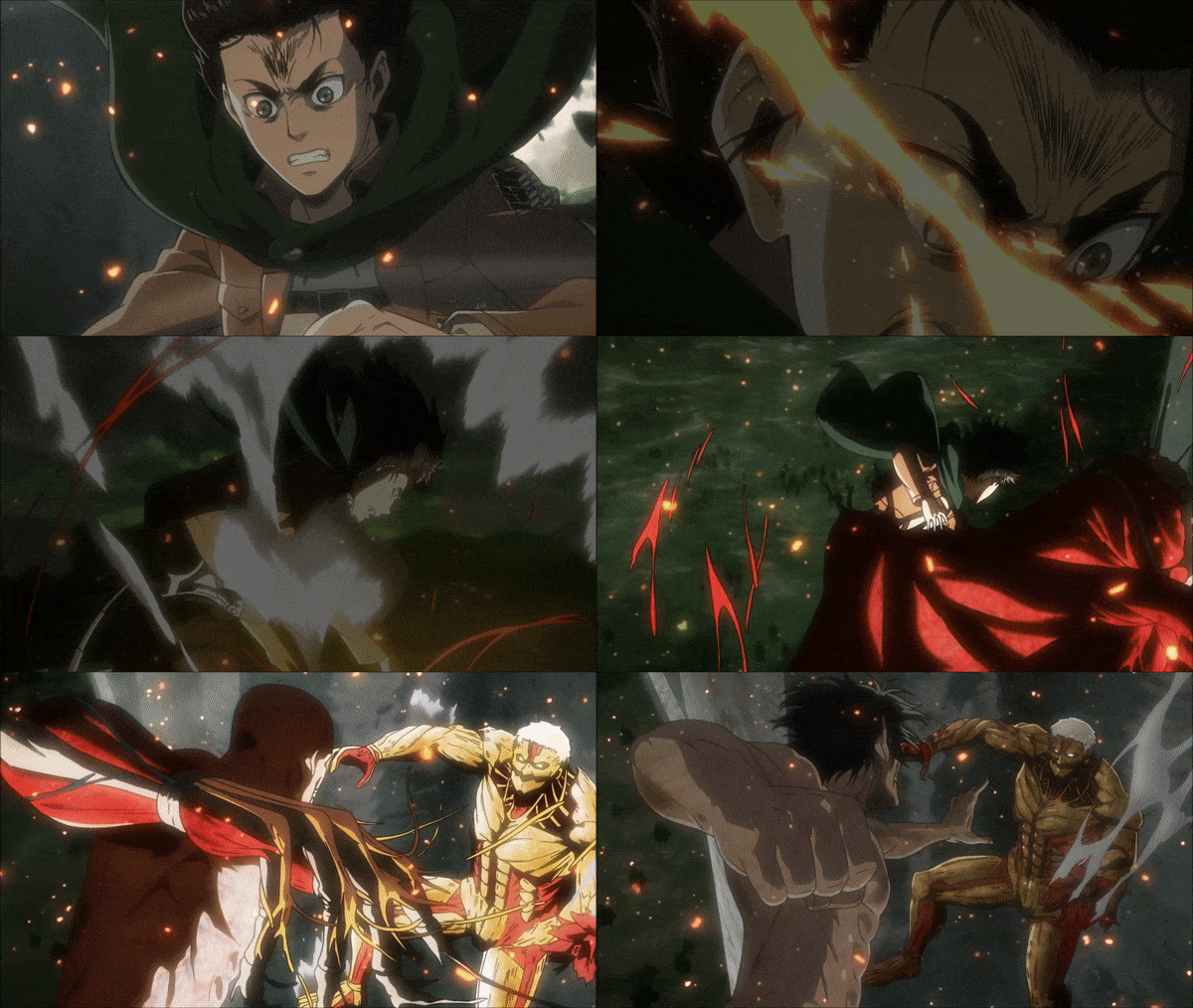
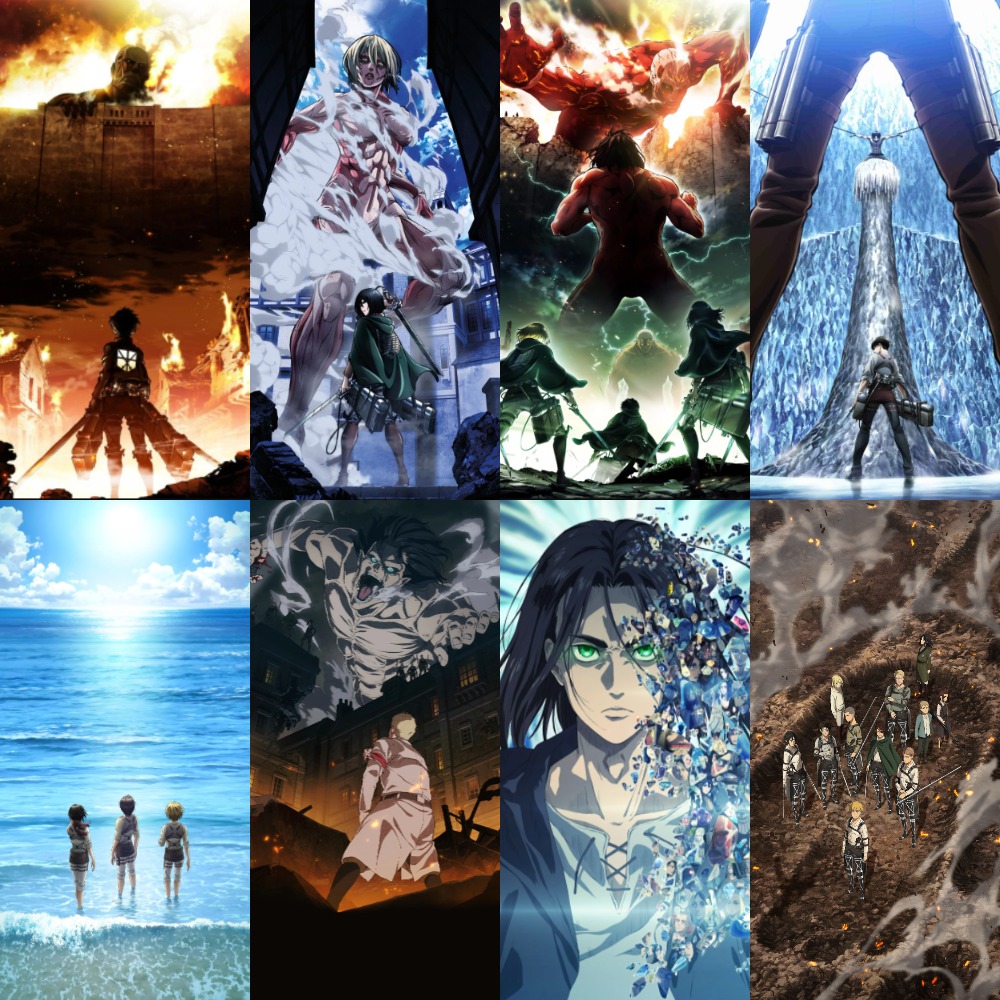
Eren Jaeger transforms into the *Attack* Titan and nothing is ever the same again. The last of humanity within the walls can finally fight back against the murderous Titan. As scouts and warriors, childhood companions Mikasa and Armin join him in a continuous battle against incoming doom from outside the walls. // Titans prove to be just the beginning. As in other apocalyptic fiction, it is other humans that pose the true threat. Opposing Titans transform and do battle with Eren and his comrades. We are eventually met with brother Zeke’s plans and father Grisha’s dual biographies. Reiner lives two lives, soon cracking apart. The minds and arcs of the characters must evolve and transform right alongside the narrative. Our heroic child warriors are growing up inside of monstrous chaos, battling relentlessly to kill their enemy.
But who *is* their enemy?
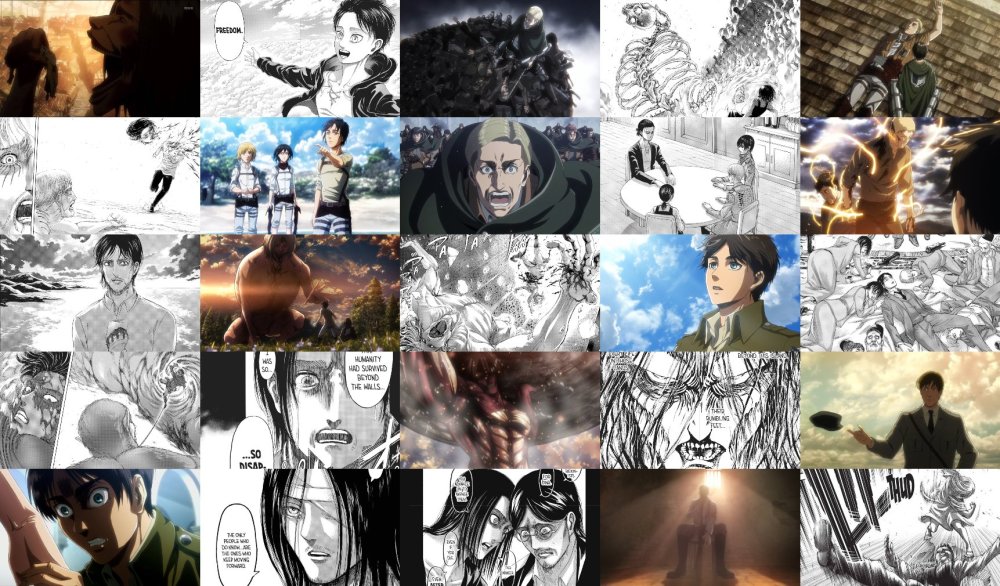
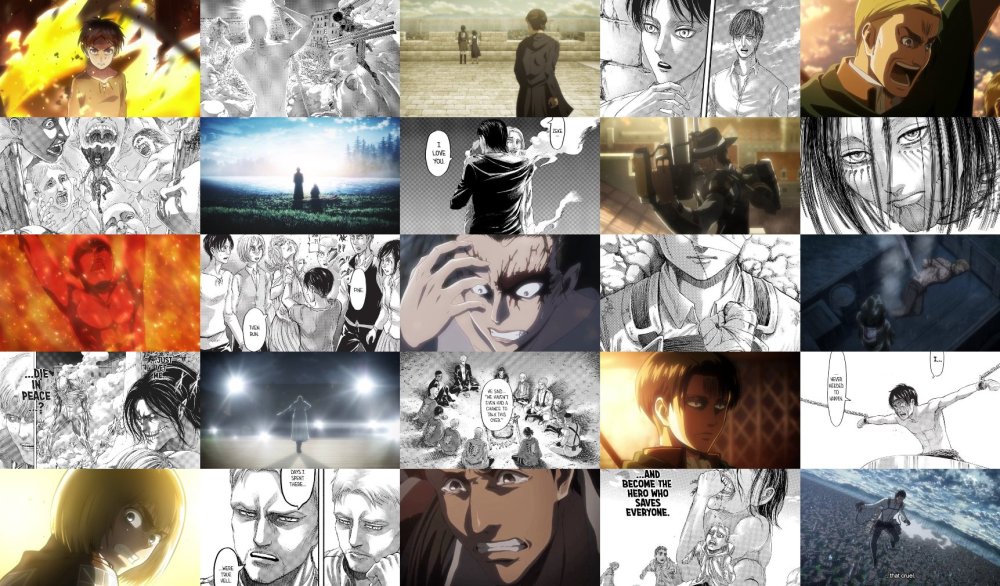
In fully exploring their world, the people of Paradis uncover their true place within history. Other swaths of humanity live beyond the walls; they on the isle are the loathed “subjects of Ymir.” The Eldians are past destroyers and present pariahs, trapped behind isolating walls of the physical and metaphysical kind, epigenetic memories manipulated and self-determination erased behind a history of imperial bloodshed and devious propaganda. Erwin and Levi and Hange and Armin and the Scout Regiment go through Hell and back again in order to triumph upon their own shores; by defeating Annie, Reiner, and Bertholdt and The Beast Titan, Eren is protected and the truth revealed. The people on the island must soon confront their greater situation. The Attack Titan’s life bounds forward into the future once more, past the bindings of an isolated destiny and eventually before the view of a boundless ocean.
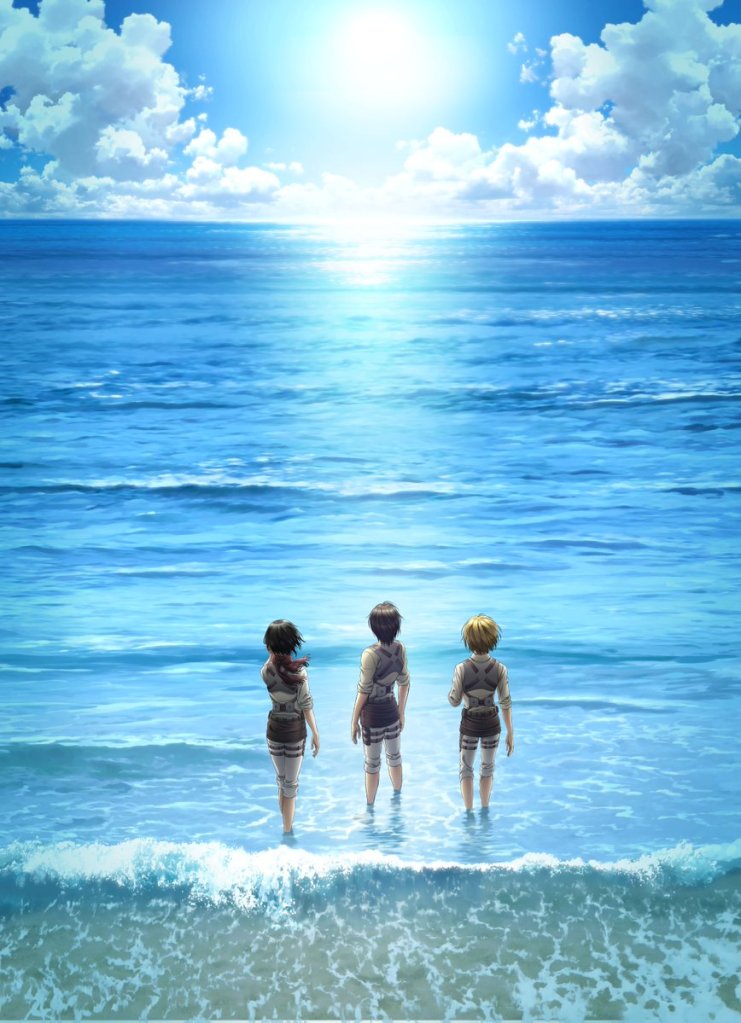
And yet, more transformations await, each more dire than the last. The true story of AoT does not begin until we go across the sea and begin the final Titan War. The Marleyan Empire is the most ardent foe of our heroes. At the same time, the rest of humanity’s nations enters the arena of the narrative’s regard. Given the apparent impossibility of peace with the island “devils,” a greater world of fearful leers dawns. Widespread prejudiced views become undeniable against a people that can transform into nigh unstoppable killing machines at the exhalation of breath or by a drop of blood. With news of Eren’s victory and his possession of the Founder’s blood, world war cycles anew.
By way of Isayama’s dealings on the nature of war’s vicious cycling and of the outcomes of imperialism and racial subjugation, there is a staunch critique of the horror of what humanity is capable of. Everywhere we turn in the saga of Eren Jaeger there is a tragedy to behold. The depiction of Titans warring for control of land and blood is a hellish vision of unfathomable slaughter. We can glean much in the observation of Eren and Mikasa and Armin’s righteous violence in defense of their lives and friends and fates, all becoming entangled by mystifying supernature and political reality. Titans have warred for centuries against other nations, under Eldian or Marleyan rule. Violence cycles itself, even becoming exponential in its escalation. Terrorism creates terrorists. Old revenge molds fresh revengers. Assassins stalk the shadows of power. Peace can be tried, as ever, but it may not hold for very long. It may take a mountain of lies to uphold anything like civilization in the Age of Titans. Of course it takes “devils” alongside a mastery of strategy, tactics, and sacrifice in order to win a war. It takes willing adult commanders training child soldiers to see other humans as nothing more than monsters, “devils” one and all, in order to build the force needed to ascend the growing body pile and achieve something called victory.
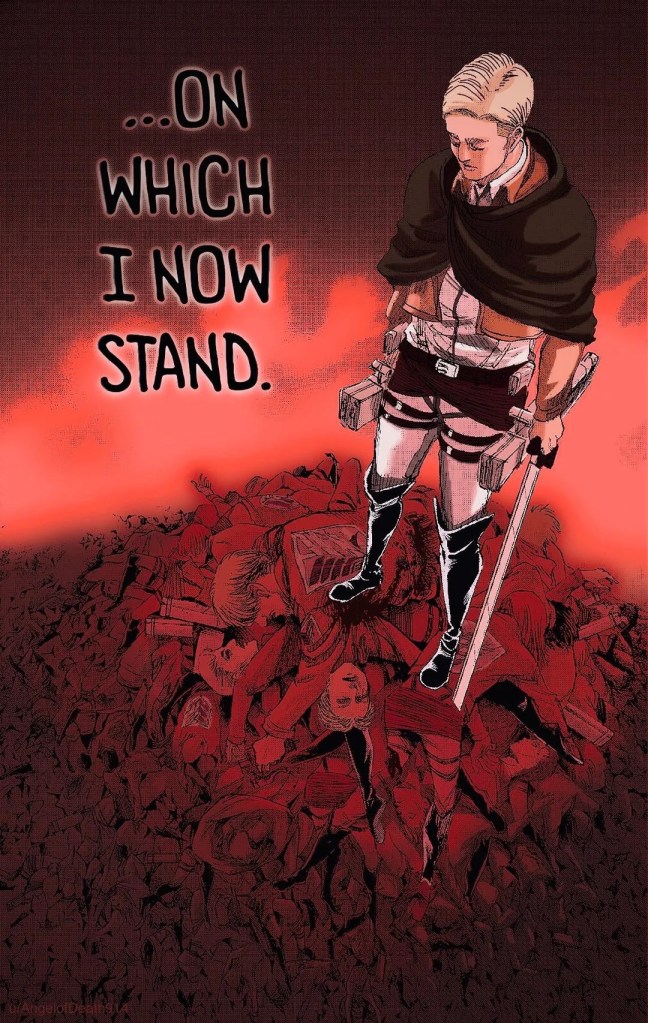
Despite all the costs and the finality of the choices made by present parties, one war may just lead to another. There may be no end to the fighting until everyone is killed or sacrificed. The despair of genocide is a firm part of Isayama’s world-build. It is a firm part of our world; it is happening today even as I type this. People killing people, soldiers slaughtering civilians, proverbial kings in power (if not in stature) expending themselves in the enslaving of souls and the ritualistic ending of new generations, not as collateral damage but as an expression of genocidal conviction, as a means of ridding the world of enemy nations and “devilish” blood. These are human truths, with or without Titans in the fold.
Remember that fascism is nothing more than a story. Like religion, it presents an eschatology beyond the chaos and death and bloodshed that is restorative and peaceful and transformative. But how do such stories really end? What can ever justify the mass murder of our human brothers and sisters? What could ever prove the superiority of one people over another?
There are false horizons everywhere. We see them all the time, in history and beyond our walls. But for those with the eyes to see, there is hope embedded inside of every vicious circle. It is the hope of *transcendence.*


Freedom is why Eren transforms. He originally wants the ability to fight, to protect, to defend his existence against the mindless monsters that threaten to trample his world. Freedom to learn, to explore, to truly see and *inhabit* this world he was born into, I believe these were some of the notions within Eren’s heart, as naive child or extremist adolescent.
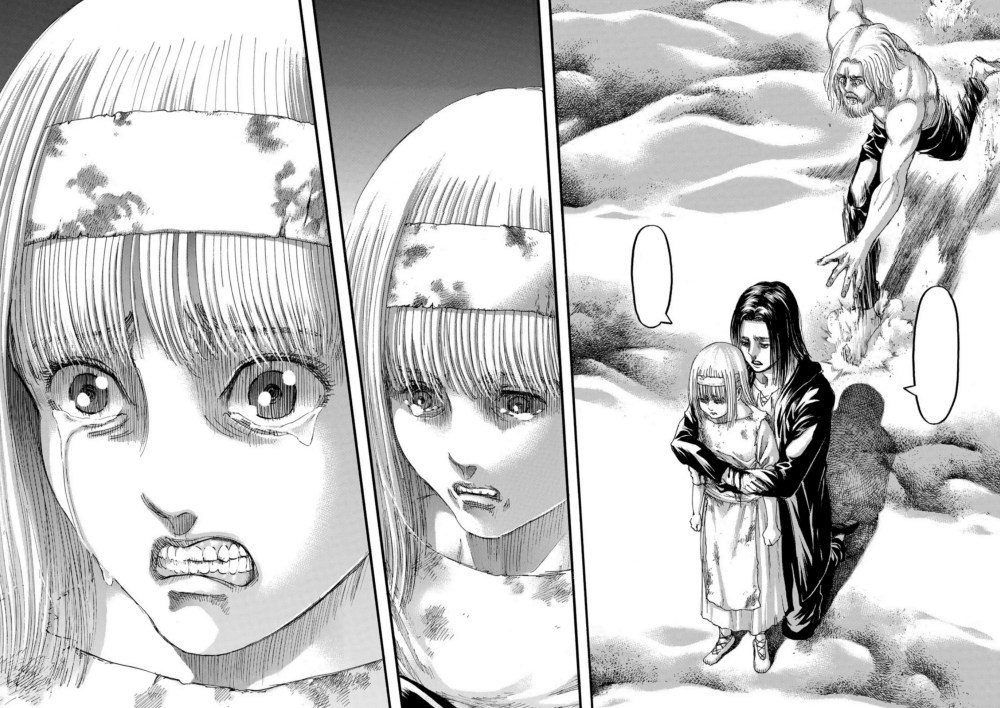
Through a timeless connection with Ymir, and the rage of 2,000 years of wretched memories and nightmarish love, Eren’s fight is co-opted by the Founding Titan. His battle becomes one to secure a permanent freedom from outsiders beyond the walls of his home. In undertaking humanity’s genocide with The Rumbling (truly beyond it, with vast populations of animals, plants, and land destroyed too), our story’s “hero” adopts the most simplistic solution before him. It is aided, if not directed, by the rage of Ymir and her apparent will to destroy.
For Eren and Ymir, it appears the freedom to destroy the world beyond their regard is the ultimate form.

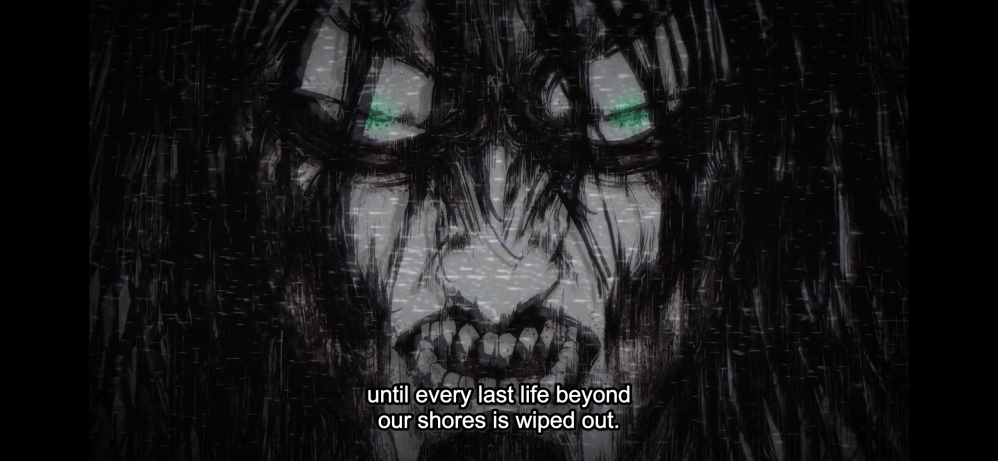
The sight of a world utterly flattened, reduced to lakes of blood, and free from “enemies” is Eren’s childlike goal.
The resolution of forlorn love and an end to the Age of Titans, Ymir’s ancient goal is to instrumentalize Eren’s will and seek a point of terminus.
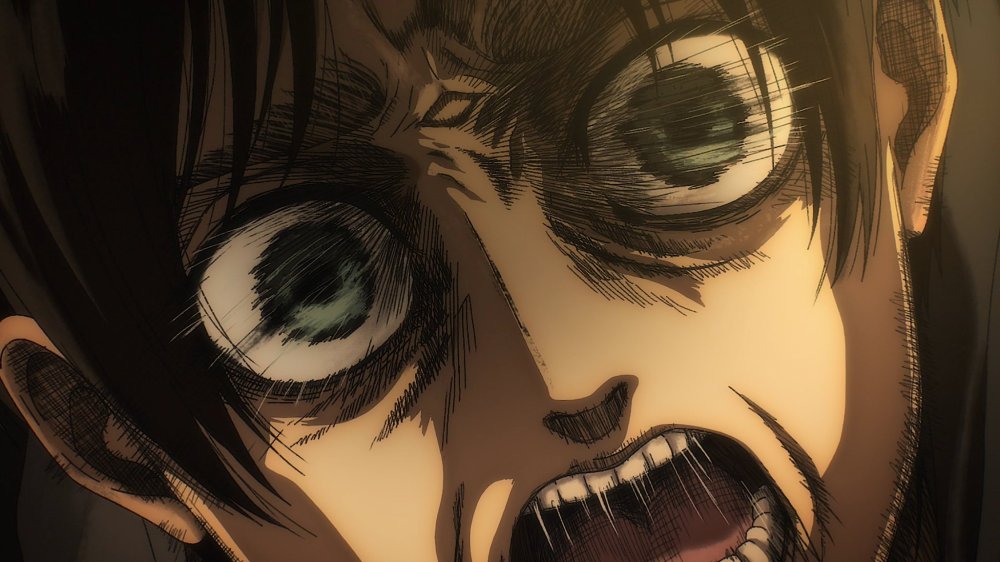


Of course, like any great one, Attack on Titan is a story open to interpretation.
My own endgame interpretation is this: Eren and Ymir represent, and indeed act as, the past and present blood memories of children who have suffered under slavery, death, and war at the hands of tyrants. So much so that they must become tyrants themselves. Ymir wandered into her deathly dream yearning to become as tall and strong as a tree; Eren witnessed the worst a human can and willed himself onto a murderous quest to become a devil that could devour other devils. Their urging toward *freedom* comes at the expense of all who would try to master them. Their story is a human one; we should not look away from sights of atrocity or avoid the word genocide. It is all here among us. Isayama can see it. We can too.
Unfortunately, it is not so difficult to imagine a world like ours producing someone like Eren or Ymir.
For every person, for every people, there reaches a breaking point. When life becomes unbearable, creatures evolve ~ we transform. When a healthy human being is faced with their death, they will resist. Fight, flight, and more. Death must be matched. An approaching killer must be equaled in animus, lest we let ourselves become past. The story of any organism is a resilient struggle to survive, it is a furious march toward multiplying, to keep moving forward as a being and species.
Life is pain and struggle.
But life is also a race up hills alongside friends, even going over them where the birds are flying and the sun is shining and the sea is lapping against the shore.

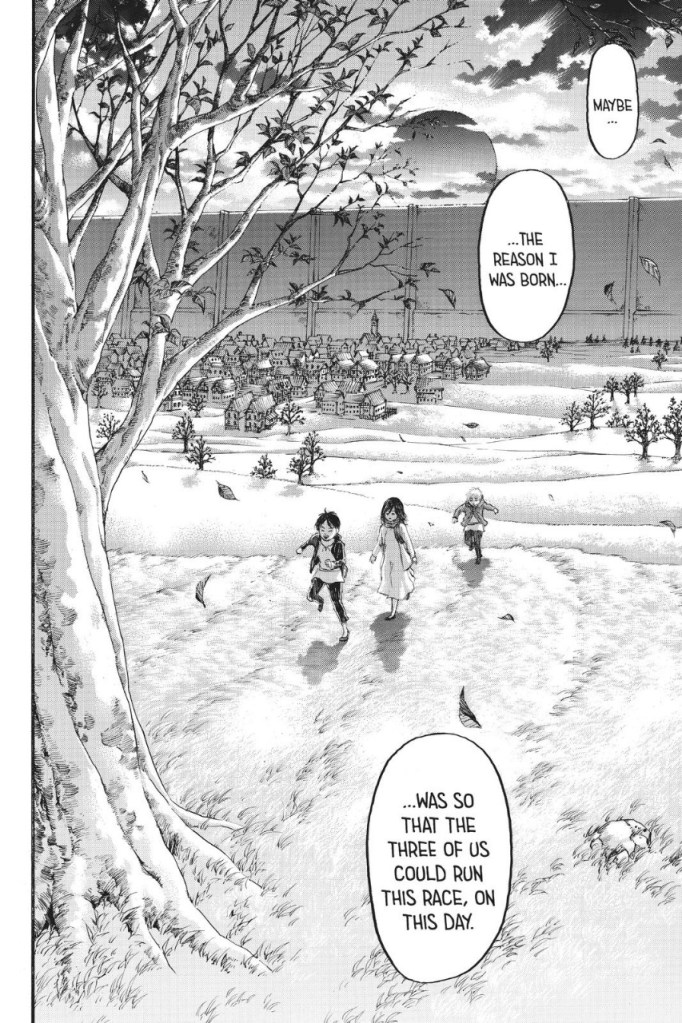
At heart, Attack on Titan is this story about transformation. Physically, mentally, metaphysically. In the end we are all children of the forest, evolving amidst a harsh environ, survivalists and warriors awaiting the barbarians over the hill or the wolves around the tree. We humans must keep moving forward. Fighting, evolving, creating. Nature demands thus: Transform, and transform again. It is enough that you were born into this world. The best you can do is come by an earnest understanding of your universe and persist in trying to better it and yourself in as long of a life as you can muster. No sin is beyond redemption; if we are to thrive, we must find others willing to share the burden of our inevitable sins. No one is alone; we are all part of the story. These are some of the things AoT said to me.
Seemingly trapped by fate, Eren ~ a “slave to the story” as Isayama states ~ became a monster so that his friends could become heroes to the world. Ymir shaped 2,000 years of human history all to find the one that would end her plight and the terror of the Titan.

Mikasa’s fate as the one to swing the sword on her love and save the world from total obliteration is a revelation of finalizing purpose. All along, Eren was the one her and the Scouts were training to kill; the story of the end of the Titans is the saga they were meant to play an integral role within. Armin’s destiny was always to tell the tale.
In the future sight of a time-lapsed epilogue, Isayama shows us how war cycles anew, now strictly human-to-human. The Eldians develop a sprawling metropolis on their island of “Paradise” but are ultimately attacked by devastating hellstorms of modern weaponry as reprisals for their people’s past sins. More creation and destruction, more death and transformation are on the way.
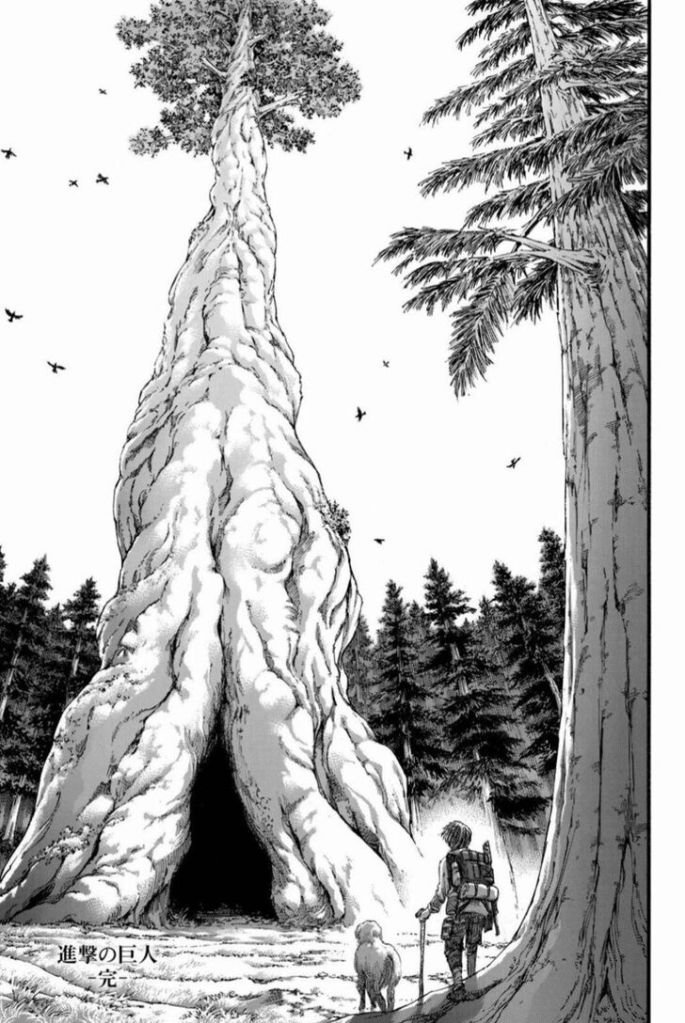
Eren’s tree, like Ymir’s shadow, stands tall over the narrative like some eschatological aion, drawing all human becoming toward it at the end of time. To me, that tree illustrates the transcendence of life, residing in a future where humanity yet persists and awaits further transformations, for worse or better. ~

 Thresholds of Transformation