~ my review & analysis of The Odyssey (2026) dir. by Christopher Nolan, adapted from Homer’s Odyssey. Spoilers ahead.

Xenia, or Zeus’ Law
Narratively-speaking, Nolan centers his ancient fantasy epic around the divinely civil conception of “Xenia.”
Penelope’s voracious suitors, Telemachus’ careful words & actions during feasts, Troy’s walls and temples, the caves and forests and huts of Odysseus’ failed expeditions — all these elements converge on Xenia, or Zeus’ Law in the modified language of this film.
A social norm as much as law of the land, Xenia governs the rights of guests and the responsibilities of hosts: one must treat guests with generosity, food and drink, and most of all – respect. Just the same, a guest’s right can be revoked by the lead host for disrespectful misbehavior, and the incentive of representing all xenos (foreigners) with your presence meant that good, ‘Golden Rule’-type behavior was in everyone’s best interests.
The initial acts of the film, with Telemachus and Penelope and Eumaeus on Ithaca sans King Odysseus lost for long at war, cast us into a tense situation held stable only by Xenia. Antinous’ gangster barbarism angling to gain the throne by enforcing a re-marriage is only barely contained by this social custom.
The Greek gods were passionate and vengeful but also sensible — just like people. Treating others as you like to be treated makes inherent sense; it also means that society could function in the long run. In that ancient world, social exchanges had divinely-inspired rules and there would be consequences if violated, if not by your neighbors than by the gods themselves. Almighty Zeus oversaw all with lightning and thunder, while Athene’s quiescent wisdom patronized leaders and foreigners. To draw their ire was to doom yourself and your bloodline.
Xenia, or Zeus’ Law, forms the overarching connective tissue in a time of war and magic. How do settlements and peoples stay together when the leaders are gone for 10+ years? How long can a kingdom go without a king? Social chaos naturally befalls the leaderless society, a half-empty throne sat by queen alone, with a son too young to reclaim it.
Nolan uses hospitality as the core kernel of his film because the most famous element of Odysseus’ resume is the Trojan Horse, a proto weapon of mass destruction. Here is where easy comparisons can be drawn to his previous work Oppenheimer. Odysseus’ sublime trick to breach the walls of Troy is the ultimate violation of Xenia. It marks the birth of a new world. Using ingrained beliefs and hospitality and the necessary offerings to the gods to silently nuke (yea) a city from within.
Odysseus’ cleverness is unbounded here; the big not-so-hollow horse worked so well for many perfectly diabolical reasons. The Trojans were as sick of the siege as the Greeks were, ready for peace to be made. Foremost, this artful war trickery has gone down in history, providencing entire canons of story adaptation and language reference, because it was a spell cast in the shared language of god-fearing custom, a sacred bond, now forever altered.
In the same way that the first man to craft a bow and nock an arrow changed the world forever, so did Odysseus (and Homer) forever change the world with their horse and their tale.
The Greeks and the Trojans shared gods and temples and faiths such as Xenia. Both peoples revered hospitality, the Golden Rule, and the opening of doors to xenos, or strangers, and the honoring of Zeus and Athena and others of the multi-polar pantheon.
Odysseus’ genius plan — for him, as a kingly soldier, a way to end 10 years of drudgery and worthless work beyond the divine walls of Troy — is really a path home.
It was also a method of breaking the world.
Matt Damon’s performance in the third act, in converse with Hathaway’s Penelope, really delivers this theme on a silver platter by the end.
“To burn the walls of Troy was to burn the world entire.”
Nolan’s thesis in Odysseus’ timbre: To break with Zeus’ law is to forever alter a world formerly ensouled with language and tradecraft and beauty, now governed by raw might, bloodletting, and duplicity. The ‘people from the sea’, raiders from foreign lands not familiar or in defiance of Zeus, are coming ashore and raiding throughout the Mediterranean world, taking homes and lives away; some are undoubtedly stories of sailors from Agamemnon and Odysseus’ returning legions doing so to ‘restore provisions.’
In violent and unsanctified ways, the world after the Trojan Horse is not the same. Nolan’s screenwriting reflects this ‘spreading plague’ of selfish violence and it is the effective crux of his film adaptation.
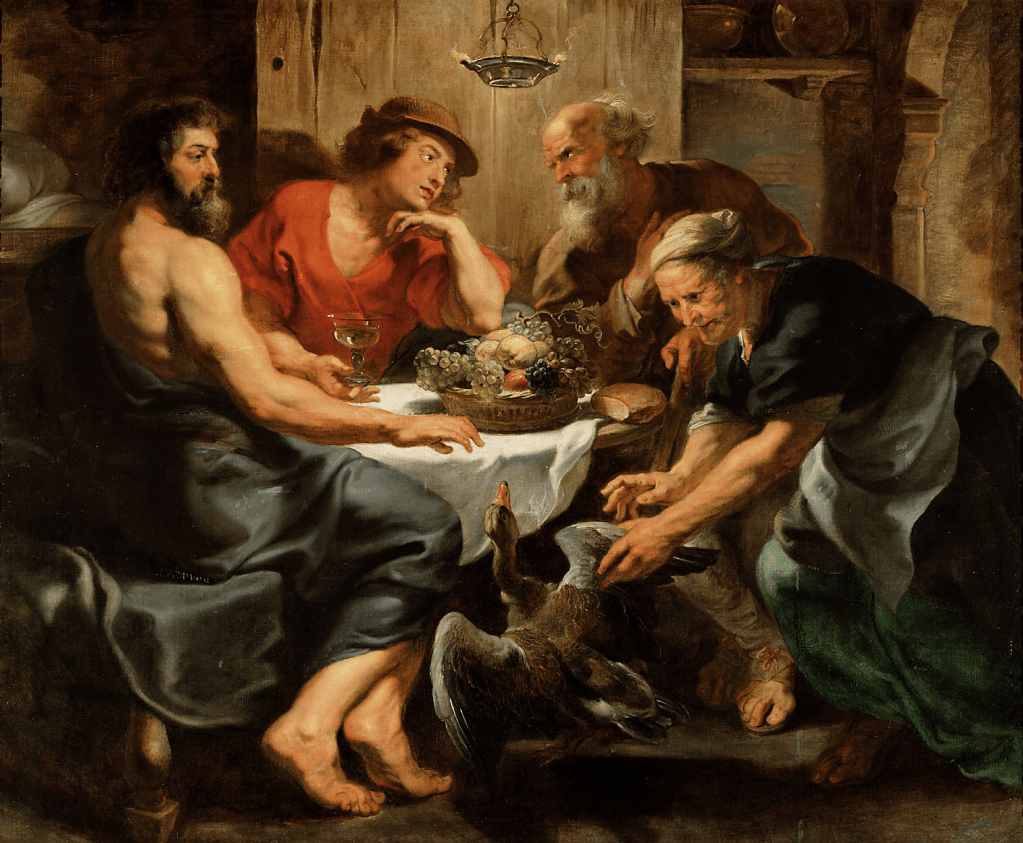
~ Jupiter and Mercurius in the House of Philemon and Baucis (1630–33) by the workshop of Rubens: Zeus and Hermes, testing a village’s practice of hospitality, were received only by Baucis and Philemon, who were rewarded while their neighbors were punished.
Playground of the Gods
Odysseus’ mind won the war, not Commander Agamemnon’s strength (or his aura).
Odysseus’ mind defeated walls built by the gods. His giant horse, an animal icon of Poseidon and falsified peace offering to Athena, bled the men that took the walls of Troy. From out of that gullet, Odysseus and Menaleus and their men opened the gates and led on the sacking of temples and the raping and pillaging of people.
Troy, in all ways a glorious place, is obliterated from Odysseus’ idea paired with the rage, frustration, and perhaps lost sense of humanity of those soldiers spending so long on a beach without progression.
When he embarks home, three ships of surviving men sailing, the threat of the war ended — the real trial begins.
Odysseus’ is the ultimate hero’s journey archetype, in form and function. He must navigate strange lands and harsh waters. Nolan’s filmmaking on this road of trials – from the cyclops to the witches and sirens, to the absolutely shocking and terrifying Laestrygonians cutting down our hero’s entourage – is sublime. Poseidon’s rage is affirmed and personified in so many horrifying encounters that take more and more lives (the various giantkin are all his children).
I found Circe’s sequence of reshaping the men into pigs especially delightful. Nolan doing body horror! What a time to be alive.

Nolan’s canon is altered in cinematic ways that work, with the giant remaining alien and the Goliath steel knights smashing his men apart, now appearing as bronze munchkin in comparison to their superior size, strength, and weaponry. This especially is about as galactic of a godly punishment for hubris as you can get.
Though the wrath of Poseidon is singularly directed at Odysseus after he blinds the cyclops Polyphemus, the sea god’s favored son, it can be inferred from his long ordeal post-Troy that Odysseus is being collectively punished — or played with — by fate, or all the gods together.
Gods seem to be saying: ‘How much can one man take?’ / ‘Odysseus the Cunning, humanity’s prime polytropos, you shall see how your mortal cleverness pales in comparison to the power of the gods…’ / ‘In what way will you react to the presence of a god in your camp, or in your enemy’s?’
Homer’s epic poem actually features round table conversations between the gods deciding Odysseus’ fate. Athena is our hero’s primary long-range support, using psychopomp messenger Hermes at key points to aid him, while Zeus serves as ally and enemy, and Poseidon forms Odysseus’ nemesis. In Nolan’s film adaptation, Athena is played by Zendaya while the other major gods are merely hinted at via thunder, wave, and fire. Damon’s Odysseus frequently sees Athena and complains of the gods’ lack of communication skills, though she rebukes him and reminds him of the essential elemental motions of the universe.
In the film, by the end, Poseidon’s monstrous progeny and Zeus’ lightning storms cast a dreadful fate on all the crew members, save for Ody. Their mistakes are explicit (don’t eat Apollo’s cattle!) and implicit (what were your actions inside the walls of Troy upon innocents?)
His men are weeded away by foes even more vicious than they are, the ultimate ironic fate given their ten years of survival against the defending Trojans in warfare. These bursts of steady bloodletting provide the structure of the message. Additionally, Circe and Calypso — as perforce feminine forces of a darker nature — both play around with Odysseus’ mind and heart and soul, reaping much pleasure and enjoyment in the process.
Ultimately, like Achilles says during the Iliad, it seems likely the gods do envy us and require our dramas to sustain them. It is our emotional force, our loves and fears, joys and tragedies, that provide ambrosia to the gods, or the World-Soul itself.
Thusly, just as it is one man’s idea that surpasses the walls, it is through one man that the gods can play out their totalizing story and make their empyrean point.
Odysseus: The Human Condition

The entire human condition lay within the journey & beingness of Odysseus.
Human hope lay within Odysseus’ frame. Can we escape a deific quagmire, with ourselves at the eye, and go back? To home, family, life. Can one anger the hierarchy and return? The answer is yes but not before supplicating yourself before the supernal.
At long last, I read Homer’s Iliad & Odyssey over the last two years; it becomes so clear how much Homer’s work forms the foundation of literature. Much like The Bible or The Tale of Genji or Don Quixote, for the aspirant author, these sources are of great understanding – and like story structure, it is best to know of them so that you can effectively borrow or divert yourself from their classic lessons as you craft your own stories.
It is through Odysseus, King of Ithaca, the most cunning of Greeks and a choice archer (arguably the most powerful lone weapon at that point in history), that Homer can tell his epic.
The key man who helms the idea to win the Trojan War – and – the lone survivor of a doomed voyage along the mystical Mediterranean coastlines of the elder world. His attributes embody and form the basis of the mythic hero for all-time: smart, strong, quick on his feet and fair to his comrades. A total proto-wifeguy, his love for Penelope is what provides his survival; his drive to make it home and to reunite with a son he’s never truly known, while Telemachus undertakes his own mini hero’s journey, is the true masterstroke of this story. And after reading Odyssey, it becomes clear exactly why this tale was one for Christopher Nolan to tell.
Nolan’s work is defined by multiple timelines, converging elements, and non-linear narrativization. The Odyssey necessarily starts in the middle, with tensions rising on Ithaca, prince and mother scrambling in their long wait for Odysseus. They doubt his return and must make hard choices. Meanwhile Odysseus is an amnesiac trapped by demigod Calypso, whose escape requires him remembering the horrors and deaths he has endured. (‘Catharsis’ is everywhere we turn in this narrative.)
Nolan’s structuring of the cinematic story is naturally brilliant. Everything compounds from the viewpoint of young Telemachus — learning of his father via increasingly personal storying from bards, kings, and later the man himself disguised as a beggar.
Undoubtedly one of the most resonant and memorable aspects of Odysseus’ story is his connection to man’s best friend, Argos, a 20-year-old dog who is the first to truly recognize the homecoming. And it’s through Argos’ tragically beautiful death that the truth of the King’s return can become known – to Telemachus and satisfied audience alike.
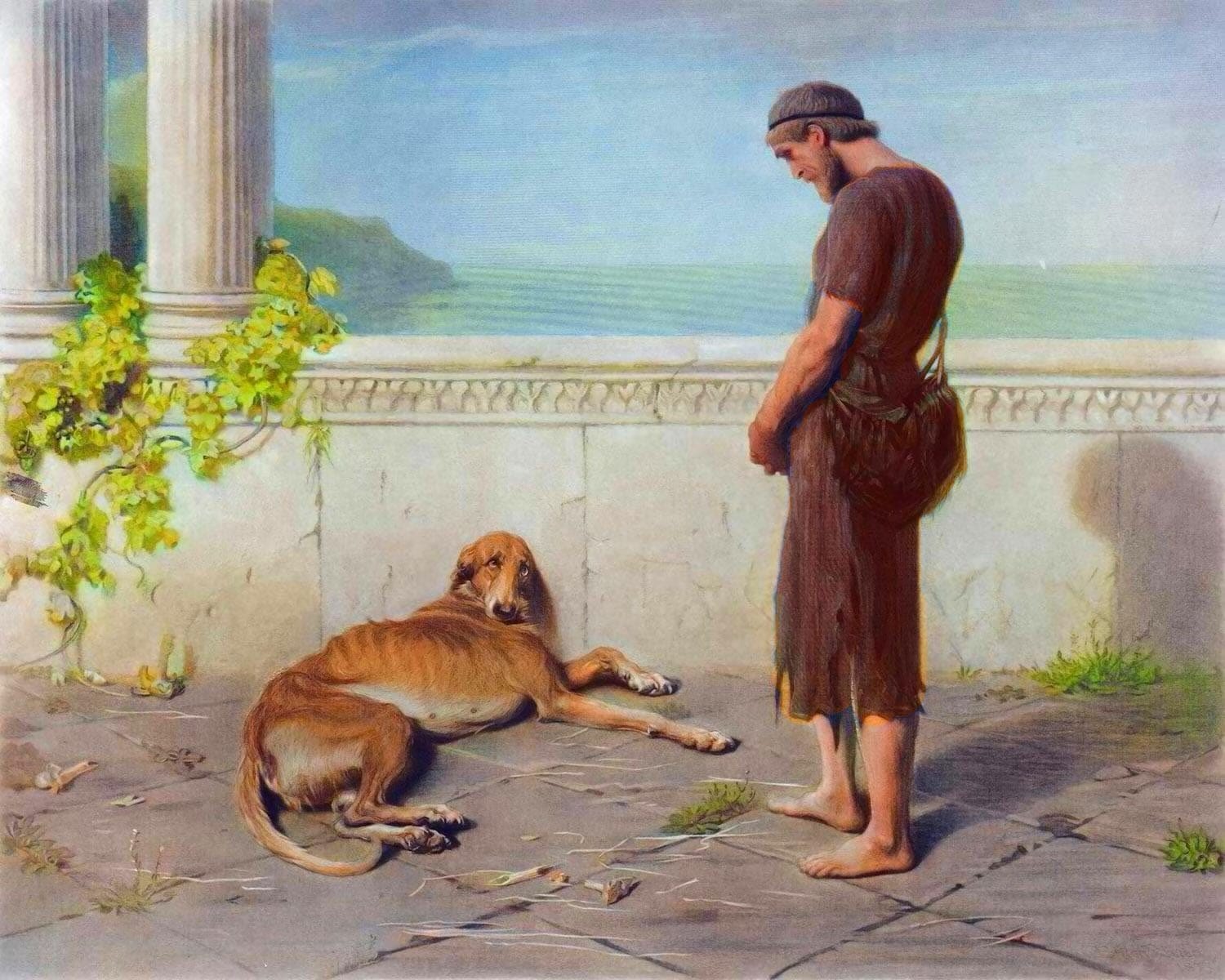
With one final touch by his master, Argos can pass on; then and there, the son can see his father has returned home. Nolan, a freshly christened dog-lover, listed this moment as one of the reasons he felt he needed to make the film.
The finale is certainly the best part of the film – and the poem too. Odysseus comes in disguise and must make use of all resources to set up a plan to deal with the forceful and parasitic suitors plaguing his castle. The convergence of all our characters after so long in anticipation is a perfect cathartic apotheosis for this tale.
Telemachus and Odysseus and Argos and Eumaeus, and finally Penelope, all play pivotal roles and provide some satisfying emotional beats to the big reunion.
The crooked suitors must kneel or fall, a mass of parasites upon his land in long violation of Xenia. And what a satisfying sequence Nolan crafts for his journey’s finale. Odysseus’ vengeful return is handled perfectly. // It was good to see Nolan’s sense for action sequences necessarily elevated for this epic finale.
And yet, after this mass of bloodletting against his own countrymen, Odysseus cannot stay home for long. He is no savior but an exhausted dispenser of old errant justice. With his son rightfully taking the throne, Ody is fated for exile, to honor his men in the ‘unknown west’ per divine decree, now happily with his wife as a travel companion and a road of sublime trials within his gut.
Christopher Nolan, through the couple’s final words as they embark on their long voyage, seems to believe that civilization can rise again, even after walls and trust have crumbled and conquest has become the new religion. Whether he’s right or not, in real life or in his fictional universe, it is wonderful to see such an ancient story & character still evoke such profound emotions and questions in us.
~ ⭐⭐⭐⭐⭐
My Letterboxd Review: https://letterboxd.com/zsoro/film/the-odyssey-2026/


