Author Diary #4: Book Walk
A late-night walkthrough of 24 of my favorite books
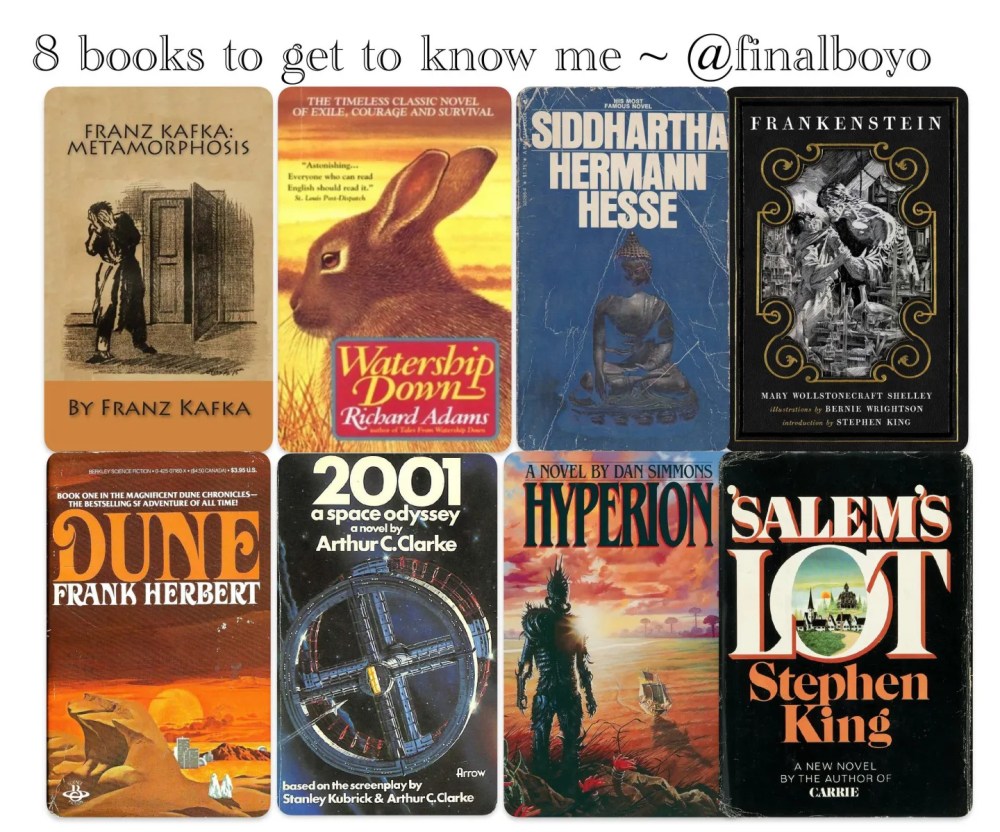
Midnight walkthrough of 24 of my favorite books off the cuff. Kafka to Clive Barker, Dune to Dostoevsky, some critical books that got me reading in the first place to the ones I love the most, such as Frankenstein and one with a vampire captaining a starship.
Grab a coffee and let’s take a literary stroll.
The Metamorphosis (1915) — Franz Kafka
First one up. My first real taste of Kafka was actually The Trial, but Metamorphosis is the one everybody knows. A man wakes up transformed into a giant bug. About a bad day and the accumulating pressure of poverty and labor and family expectation.
Kafka’s language is sharp, and “Kafkaesque” has earned its place as its own word: weird, uncanny, things out of place, absurd. The genius is the non-sequitur. Someone turns into a roach. Why did this happen? How does this work? You are never sure where any of it is going. Kafka’s brainflow sits right next to Camus and Kierkegaard for me, the two philosophers I have read the most.
Watership Down (1972) — Richard Adams
Profoundly emotional tale of action-adventure on the scale of the bunny. Bunny Wars, in some ways. One rabbit has a premonition that the warren is about to be destroyed. Nobody believes him, so he leaves with his followers to find a new home. Chase scenes and great escapes. Found family bunnies banding together while worldly threats enforce resourcefulness and some great moments of wit and guile.
It gave me the confidence and the framework to write a small, tight-knit group of animals. I have a whole rabbit and hare sequence in my first book that came directly out of it. I wrote a big long essay about this one (https://thresholds-of-transformation.blog/2019/03/07/watership-down-essay/). I loved it.
Siddhartha (1922) — Hermann Hesse
A short, deeply digestible book. The way Hesse reaches the heart of it has everything to do with the river. He writes the way great writers do, powerful and simple at the same time, which is its own kind of art. Profound read.
This stretch of my reading is also where I started learning how to structure an essay and how to stop writing sentences that were too complex, too many compound clauses firing at once. That took me a long time to figure out. Need to read more Hesse.
Frankenstein (1818) — Mary Shelley
I love the gothic. Frankenstein has the benefit of being wondrously imaginative: the created monster, the mad scientist, all the things that carry on from it through the next two centuries. Shelley pulls from ancient material and grounds it, so it lands with real human, scientific, and philosophical weight.
At its core it is a story about creation and parenthood. Your offspring is your offspring. You can love it and do it right, or you can go to war with your creation because you find it grotesque. Frankenstein is special to me in a thousand different ways. I have read it more times than any other book and I based my sci-fi novel Cyber-Serial on it.
Dune (1965) & 2001: A Space Odyssey (1968) — Frank Herbert & Arthur C. Clarke
Sophomore and junior year of high school is when I got serious about reading. I started googling the best books of all time, the best fantasy, the best sci-fi.
Clarke is doing hard science. He writes about the engines and the systems and everything happening aboard the ship, and he is just a genius at making the craziest far-out fiction readable and brilliant at once. Herbert’s worldbuilding of Dune is insane: ecological, economic, the psychic visions, the priesthood, the interstellar order, all of it anchored by desert wurms.
Hyperion (1989) — Dan Simmons
One of the great sci-fi books. I read it in college while interviewing for internships, genuinely nervous about my whole career. I was locked into it in hotel rooms while I traveled. The structure is a group of travelers from different places brought together on the same pilgrimage, each with a story, all heading toward something important. A Canterbury Tales setup carried into deep space.
I need to reread this one soon. Simmons also wrote The Terror and Carrion Comfort, both considered classics and on my TBR.
‘Salem’s Lot (1975) — Stephen King
Here is where I lose myself in horror. ‘Salem’s Lot was the first novel that actually freaked me out, chills up the spine, oh gosh this is good. Which was wild, because it is a retelling of Dracula and I had already read Dracula by then, and it had not scared me.
King shifts perspectives, drops you into different mindsets, and builds a plot that is so satisfying to watch go wrong. My favorite part was the kid character, who I wished to emulate. I read Goosebumps as a kid, and I still remember The Mask, but I was not an avid reader until high school. ‘Salem’s Lot was a book that truly grabbed me and made me put everything else aside.
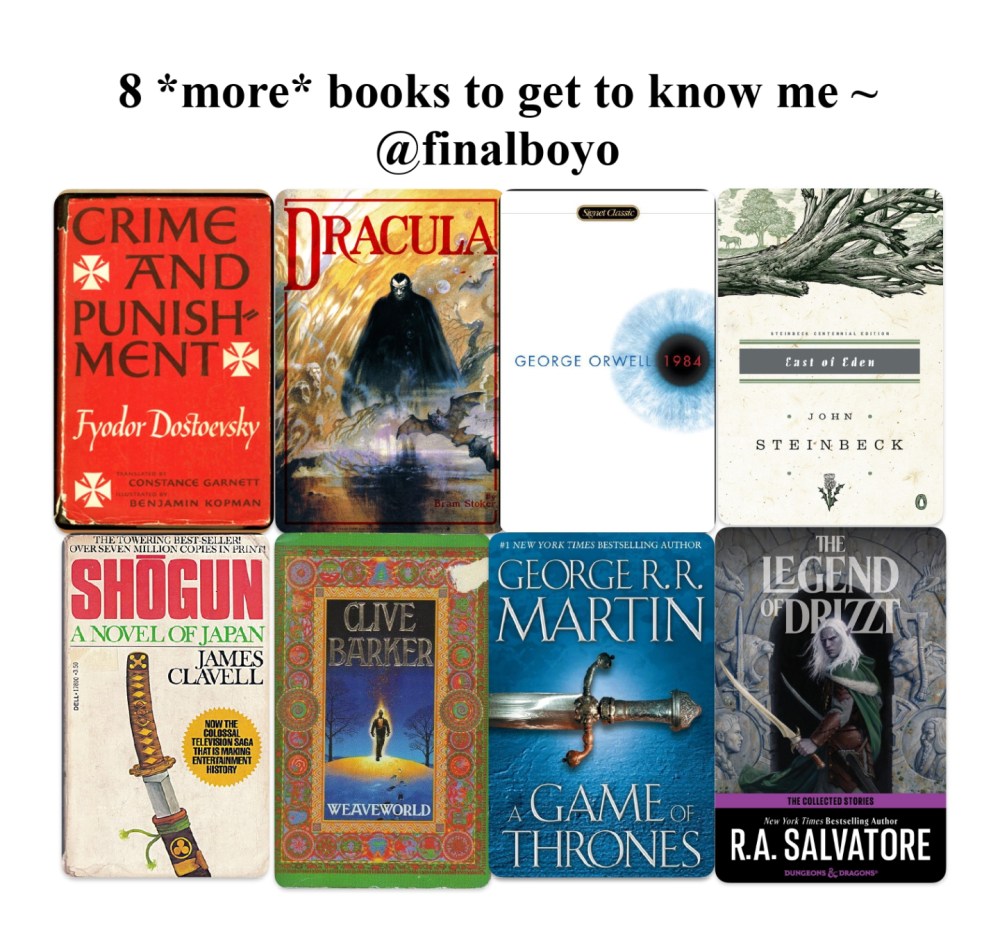
Crime and Punishment (1866) — Fyodor Dostoevsky
Dostoevsky is one of the greats, and this one digs straight into the heart of philosophy, murder, and emotion, into what it is actually like to be a person. We get to see the manic ascent and belabored descent of the criminal mind.
Dostoevsky belongs with Kafka and Nietzsche: brilliant minds and fantastic artists who lived hard lives. He had one of the craziest lives ever, an enemy of the state, a criminal. He will live forever, for good reason. When someone of genius has an avenue to unleash that into the world, you have to appreciate it. A book best read when you are older.
Dracula (1897) — Bram Stoker
Dracula is an imperative marker in the timeline of all fiction. Not just the Dracula castle setup with vampiric lore affirmations, but also that of the vampire slayer, Abraham Van Helsing. Helsing stands shoulder to shoulder with Sherlock Holmes in terms of cultural relevance and impact. Buffy carries on Helsing as well as Hellsing the animanga and Hugh Jackman’s Van Helsing too!
1984 (1949) — George Orwell
Orwell is the example of clean, crisp, easy, and profoundly deep all at once. He works like Hemingway, getting a great deal done very quickly with concise language.
1984 is scary because it told our future. We got the surveillance, sure, but we also got the ads and the McDonald’s and a chintzy, childish, twisted consumer version of the nightmare that is worse in some ways than the original vision. And through all of it people still fall in love while the infrastructure falls apart. One of my favorite other pieces of Orwell is actually his writing about writing.
East of Eden (1952) — John Steinbeck
Steinbeck’s big generational saga, and the book on this list that draws its deepest inspiration straight from the Bible. You can feel that rich, foundational scriptural lore running all the way through it: the old Cain and Abel story playing out again across a family, brother set against brother, good and evil wrestling inside ordinary people in the California valleys.
Shōgun (1975) — James Clavell
This one was recommended to me on Reddit, a point in Reddit’s favor, and I read it well before the show. Clavell is a god-tier writer and prose stylist. The first thing you notice is how well it is written, engaging and easy to read while he twists you through a completely foreign world: learning the Japanese language and the ways of its people, a man forced to prove his worth, executions all around him, information and wit as his only leverage.
Weaveworld (1987) — Clive Barker
My pick from Clive Barker is Weaveworld, his sprawling dark-fantasy epic about a whole magical world woven into a carpet and hidden away from our own. The first Barker I actually read, though, was The Hellbound Heart. Read it on a flight and was blown away.
Barker is sex and violence, sure, but he operates at a level of confidence in his language that is undeniable and greatly appreciated by me. He is audacious, willing to go anywhere. Cenobite hooks coming out of the walls, yanking stomachs and spleens. The difference between Barker and empty torture is the extremity has to be in service of something rich and mythical. He is painting with a full palette. He taught me more about what is possible on the page, and Weaveworld is an imaginative gem.
A Song of Ice and Fire (1996) — George R.R. Martin
Game of Thrones, popular one. It is geopolitics, lorecrafting, economics, the strange ways history repeats, power-mongering, rebirth, dragons and magic, all of it kept reserved and realistic. Epic battles and strategic blunders, weddings and hunts, the turn of history runs on contingencies and, of course, the strangest and most extreme personalities. GRRM puts together a dream of a story tapestry with these novels.
Unfortunately for the GOT book readers, these epics get so large that they become difficult to finish. Martin is not alone: Togashi’s Hunter x Hunter and Miura’s Berserk (R.I.P.) — two of my other all-time favorites — suffer from similar hiatuses. Rest in peace, Miura. Some stories are so big that it becomes hard to keep sacrificing your body and mind to complete them, and health gets in the way.
The Legend of Drizzt (1988) — R.A. Salvatore
Salvatore’s Forgotten Realms books got me into seriously reading, and coming back to see what Drizzt the intrepid swordsman would do next. The drow, or dark elves, are wonderful antagonists and rich lore within the world-building. Drizzt Do’Urden, a future ranger with a morally good heart, must escape his subterranean society and seek the surface, and a new beginning…
The great highlight is his father, Zaknafein, a kindred spirit who shared Drizzt’s heart but did not find the courage to resist. It is like Luke and Vader. You can argue Salvatore is the greatest fight-scene writer ever. People who know, know.
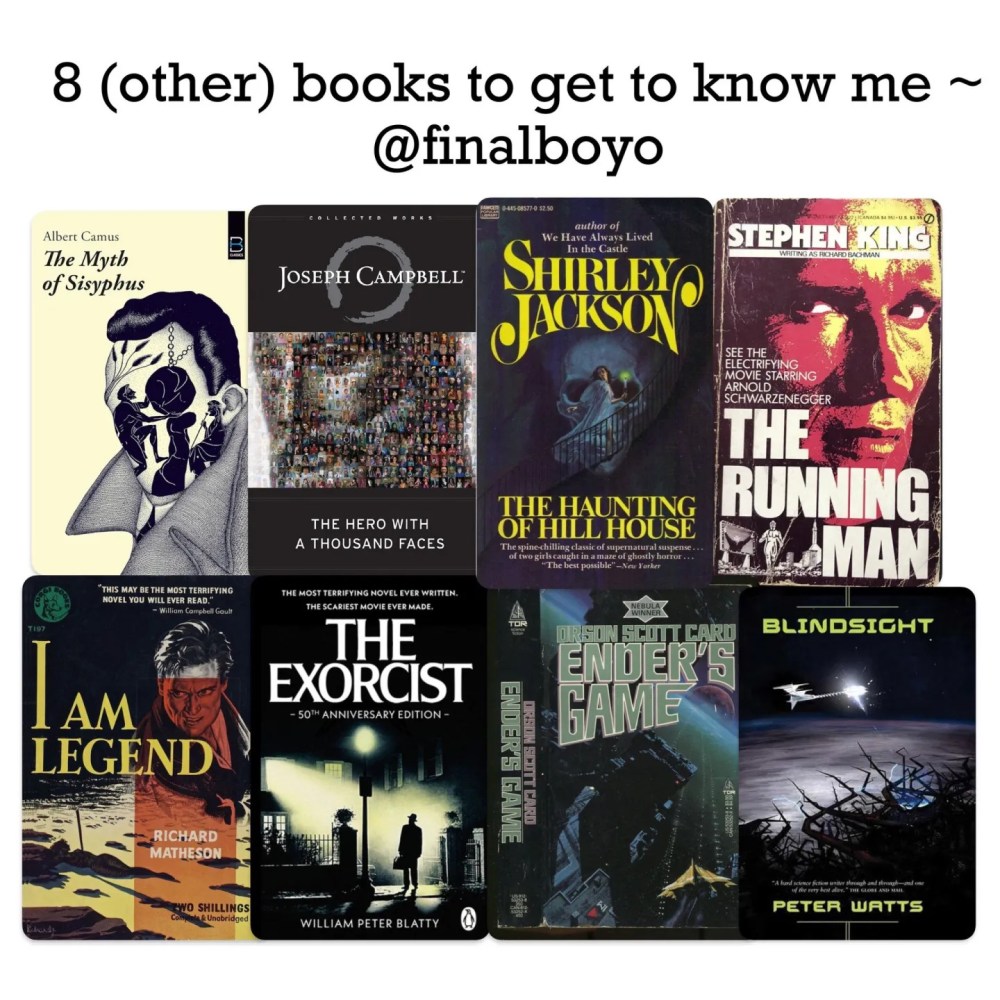
The Myth of Sisyphus (1942) & The Rebel (1951) — Albert Camus
Camus is a brilliant writer, crisp and clear like Orwell, but he pours his whole heart and his philosophy onto the page and speaks the truth plainly. The Myth of Sisyphus and The Rebel are both nonfiction, both wrestling with the hardest questions: suicide, how to live, how to rebel, what revolution really is.
Camus and Kierkegaard run through my fiction in many ways even I don’t understand. Sisyphus, condemned to roll the boulder, the trickster who once trapped death itself, becomes the proof that existentialism is a great freedom. You are not abandoned to fate. You are always choosing, no matter what the choice is. Viktor Frankl speaks to the same thing: meaning found even inside suffering, if you are imaginative enough to step out of your circumstance and into a new vision.
The Hero with a Thousand Faces (1949) — Joseph Campbell
A seminal book. I have written a lot about the Hero’s Journey. Campbell connects straight into Jungian psychology: good and evil, conscious and unconscious, sympathy and empathy. This is what stories are about.
It is the ultimate book for understanding mythology and the common structures underneath all storytelling. Star Wars and everything else draws from this well. In a sense you already know the Hero’s Journey because you are a human being and it lives in the collective unconscious.
The Haunting of Hill House (1959) — Shirley Jackson
I met Jackson through The Lottery, one of my favorite short stories ever, shocking and diabolical. Reading that, and reading King, is when I realized I smile at the gnarly, messy stuff. I like the extremes of things, especially in art and especially when they are pulled off well. That is why I love what Barker and Cronenberg do.
Hill House itself is a lot like Metamorphosis: a bottle story, the way 12 Angry Men is, with almost everything held in one place. Not much technically happens, but the psychological journey of the character gets under the skin. A language feast and a psycho-realistic approach to the paranormal tale.
The Running Man (1982) — Stephen King
Action thriller set in a dystopian future built on more modern tech, a game show where you have to run from assassins across the world. Bombs, chase scenes, plane hijacks. It is a cocaine story, and King was on cocaine when he wrote it, which, honestly, good. God willing, we all get our cocaine stories.
It is the biggest inspiration for Swarm, the first thing I had in mind when I wanted to write something in that mode. What I take from it is pace: how fast you can drop into the action, how quickly you can move things along, this is the reality you are in, go, go, go, get to the good stuff. It is eighty percent cake, all good stuff, and King simply never slows down. A breeze to read and genuinely inspiring as a writer.
I Am Legend (1954) — Richard Matheson
Matheson is a legend in TV writing too, with a lot of great Twilight Zone episodes to his name, including the gremlin-on-the-wing one. I Am Legend is a last-man-on-earth apocalypse that is also a vampire story. A vampire plague hits, and he ends up the only human left in his area. He spends his days hunting and staking vampires where he finds them, an evolution of Van Helsing, and a fruitless one, since he believes no one else is out there. Then he meets a survivor, tries to connect, and the story plays out.
It is another of my early essay subjects. Matheson is a craftsman and a basic-in-the-best-sense prose stylist who does not try to do too much, and the honest truth is I probably write closer to him than to anyone else on this list.
The Exorcist (1971) — William Peter Blatty
The Exorcist and Hellraiser are top-ten horror films for most of the world, up there with The Thing, Alien, The Texas Chain Saw Massacre, and Halloween. But the book is fantastic in its own right, and Blatty wrote it as a true Catholic who believes all of it is real. To him this is the battle of heaven and hell, fought through human souls.
It layers a religious terror story over a hero’s-journey priest story with a detective story inside it. If you are a Christian it will likely affirm your faith, and either way it makes you believe a little more in the goodness of humanity and the power of faith.
Ender’s Game (1985) — Orson Scott Card
A perfect book, and great for kids, because at its heart it teaches empathy and teamwork. I read it in high school, on my own rather than for school, and it taught me leadership: the leader who listens, who gives each person the autonomy to play out their own role, so that as each person gets stronger the whole group gets stronger and can then teach others.
Ender trusts Bean and Petra to play their sections to perfection while he oversees the whole orchestra. Underneath all of that there is the war, the sci-fi, and the political intrigue with Valentine and Peter. Card is one of the greats. I have read his short stories and basically all of the Ender and Shadow books. One of my favorites.
Blindsight (2006) — Peter Watts
The last one. I read Blindsight in college, checked out from the library. It is a wonder at the edge of the universe: something happened on Earth that sent us out into the dark to seek a beacon, a 2001 setup, and what we find is a living thing, a parasite that attaches to the ship and turns everything into a nightmare. A derelict-horror crew story carrying insane philosophical lore.
Watts is a genius of hard sci-fi, and he is really writing about crew dynamics under pressure, a submarine in space, people who start to lose it and turn on each other. And the kicker is the captain. In this future there are vampires, a rare, proto-human apex predator that has been around since the dawn of time and can think in five dimensions, basically a living AI who could run the whole ship alone. Everyone fears him because he could kill all of them easily. Throwing that into hard sci-fi is a crazy move, and I love it. Watts goes in and has fun on the page. I am striving to do the same every time I sit down before my own pages.
Heading Home
That’s it for Author Diary #4: The Book Walk.
Thanks for listening.
Let me know your favorite books.
I am always expanding my to-be-read list.
Godspeed,
Dylan Orosz

 Thresholds of Transformation