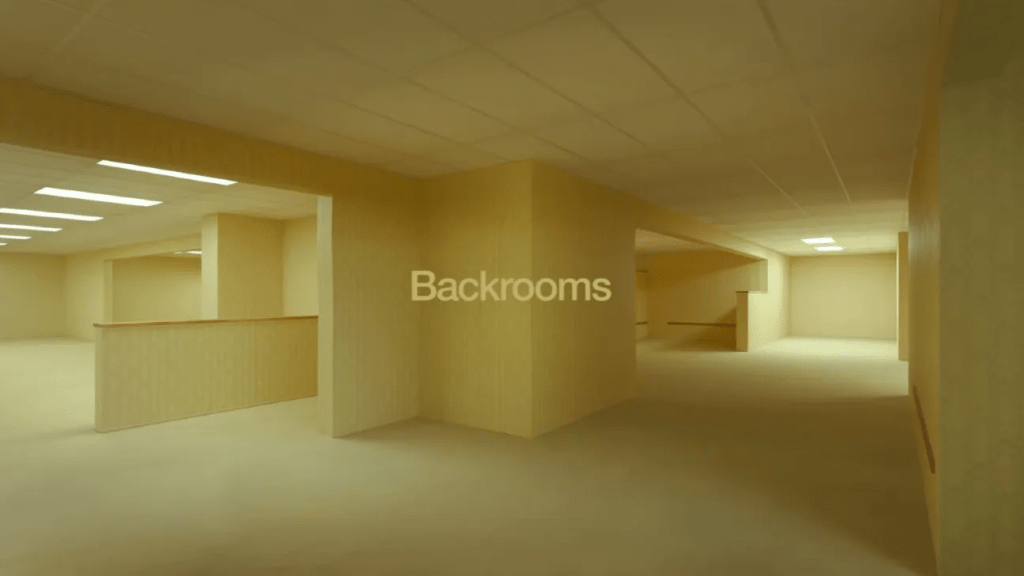
~ my review of Backrooms (2026) dir. Kane Parsons. Spoilers ahead.
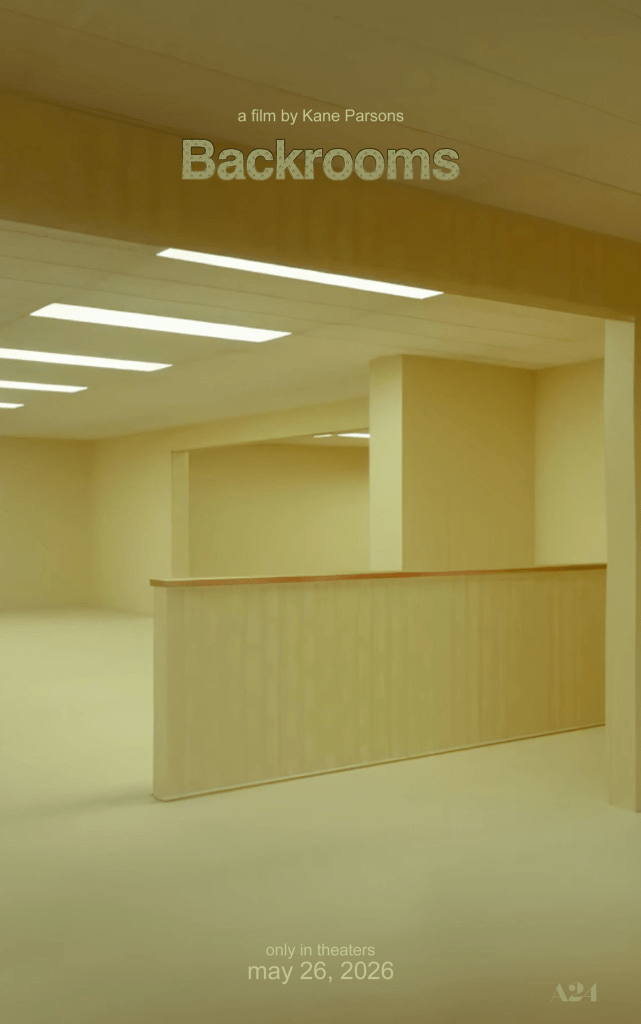
A labyrinth of haphazard memories.
A rut of bad dreams.
A loop of coming futures.
(I kinda wanna go in there…)
Escaping Reality
Backrooms takes place in the summer of 1990 and follows a duo of characters: Clark and Mary. One is washed up, angry, and a recently divorced furniture man. The other is a therapist with a book out but without firm direction in her social life. Both are lonely. Each seek out escapes from their life’s tedium. Mary reads and hosts parties; Clark finds solace, oddly enough, inside the Backrooms.
Backrooms (2026) is Kane Parsons’ visionary attempt to launch his singular yellowish demizone into a true feature. Produced by A24 and overseen by various masters of indie horror, the film was set up for success. Further so by the pair of lead actors, proven performers that provide a core emotionality to the film. This contrasting emotional core, of Clark and Mary, is necessary for the full truth of the Backrooms to be revealed.
Spoiler: They are escaping into realms they have unconsciously helped to create due to their most discordant emotions. {like we so often do}
What is most sad to me was seeing Clark languish as a small business tyrant and Mary suffer from such dire alienations, all while they are living inside of the very beginning of the last great decade — the 1990s.
Knowing what we know now, who would want to escape the 1990s?!
Devouring Lives
My basic interpretation of the Backrooms is that it’s a cinematic form of psych Carl Jung’s ‘Collective Unconscious.’ In a quantum way, this other-dimensional place connects, or latches, to us the more we take notice and interact inside its uncanny space.
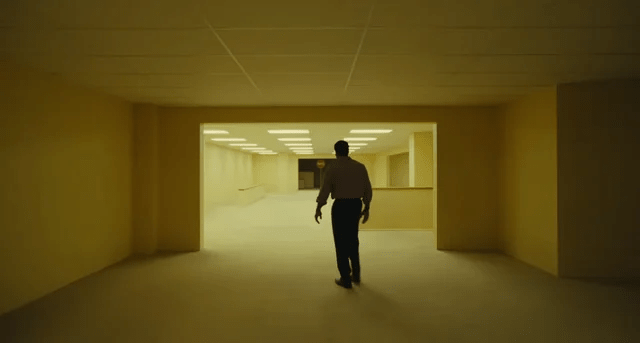
Perhaps ‘parasite’ is a better descriptor, a feeding force, like a psychic vampire or a hostile alien slurping human “loosh.” There is a direct feedback loop from our actions back into the estranged space. // For Clark the place becomes a paradise, a space for him to be at peace, without the responsibility of life or relations or bills — and with the added bonus of being a madly curious place an aspiring architect like him can map out, even learn from.
Either way, at any rate, no matter how you look at it: the Backrooms ends up devouring the lives that enter it, mind and body. It is not a place that leaves you.
You’ll notice how much of the inner ‘scenes’ within the Backrooms are the direct renditions of the characters’ items or actions. Pieces of their clothes, their abodes, their bodily positions on the surface are copied and sunken and half-melted away.
The Backrooms acts a predator, more like the Venus flytrap than the xenomorph, absorbing nutrients slowly until it can eventually devour the person whole. {Is there any consciousness or is it all automatic? What might the interiority of humans taste like?}
During key sequences of terror, Kane’s claustrophobic camera work is wonderful. He produces an omnipresent aura of uncanny dread as we follow characters further into the maze. An experienced gamer, he is capable from 1st and 3rd person POVs on the explorations, both fast and manic and slow and dreadful.
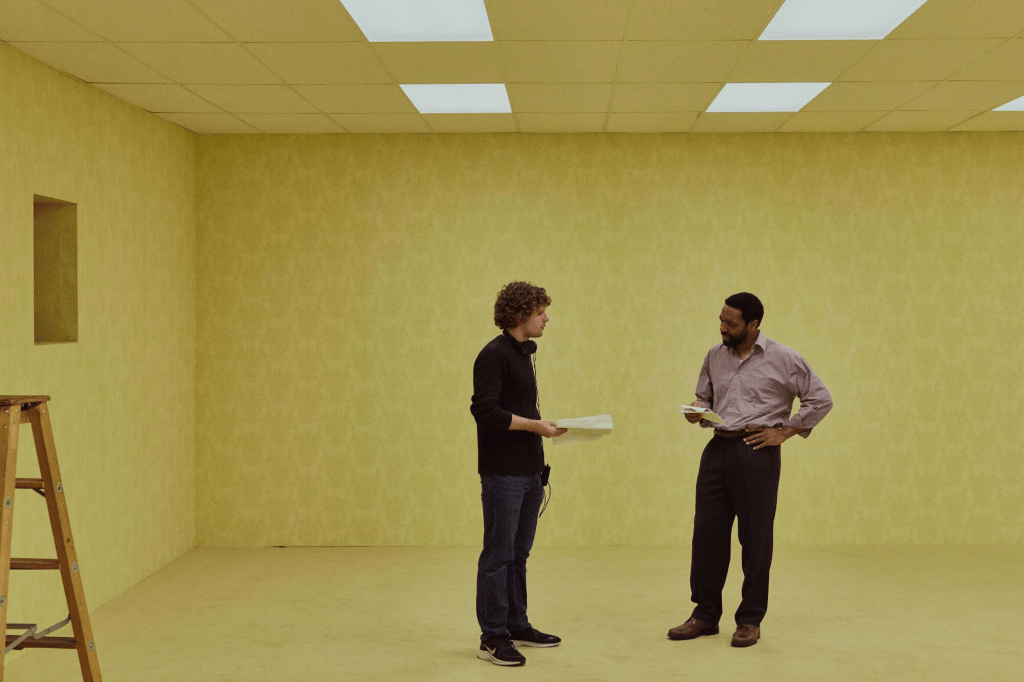
The weirdness of the Backrooms is bolstered most of all by the fact of it being a real set, with tactile shapes and angles and scents too {I’d imagine}. // Question: Did Kane Parsons build the Backrooms or did it simply use him as a vessel to build itself?
Procedural Soulcraft
So what the hell is the Backrooms? An infinite maze? A winding piss-yellow multiform set of corridors that opens into pools, goes vertical and abstract, constantly resembling modern unhinged art in many ways. It actually moves on from the poor wallpaper and becomes tile, stone, entire cake-sliced apartment buildings and gargantuan zombified department stores.
How does this place build out? What is the mechanism, the source? How does it keep going and going? As the film plays out, one can see the seep of lives all over the place. The Collective Unconscious made manifest but accumulated foremost on those within reach of its jaws. We learn it copies the surface world, “remembers” places and objects and people too. The more it recalls and repeats, the less normal the reproductions become.
“It is every place that ever was.”
It echoes the exterior locales of the lives it invites. Local Santa Clara signs and furniture from Clark’s store and Kat and Bob’s shoes and shirt all end up down there. We come to see the strange space is hardly confined to inanimate objects alone, it is indeed able to animate. Some of the grotesque simulacrums of ‘people’ are hostile, willing to kill humans that enter, while others are simply still and merely reactive.
The Backrooms appears to interact especially and necessarily with humans in all these ways, their outer and inner being.
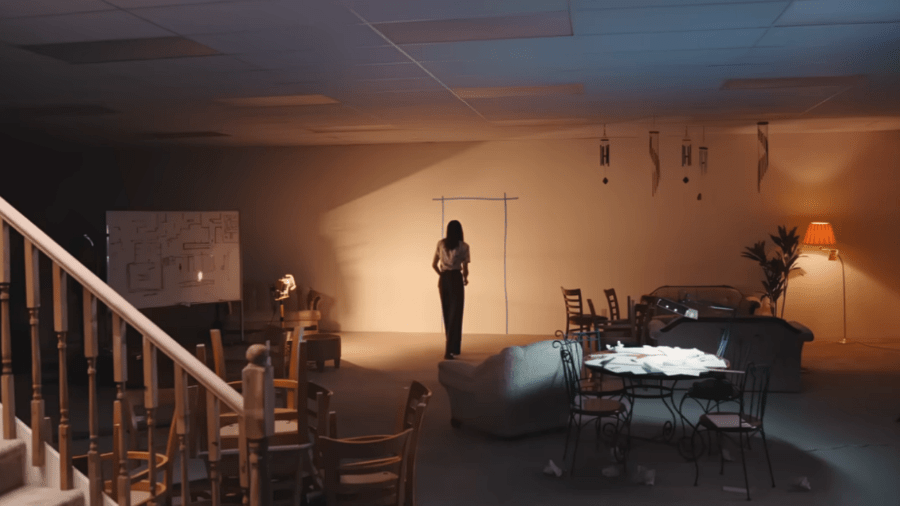
Intriguingly, the wind chimes from Mary’s childhood appear outside of the portal in the basement, a clear indication of the Backrooms’ progressive counter-seep into our reality. There is a two-way street. There is a mass osmosis of our Overworld and this Back-World.
Pay attention. Notice how the furniture vortex has disappeared for Mary’s arrival into that initial landing zone; later she sprints through a horde of more low-hanging wind chimes and her whole childhood living room is warped from a hoarded mess into a blank grey-green passage with an abyssal arched threshold. The Backrooms can shift its shape, adding or taking away seemingly at-will, feeling the unique traveler inside its belly and populating for them — or through them — in a procedural way as they explore its interior.
In the gutting, magnificent final shot, Mary is reproduced as a Still Life figure during the moment of her nervous interrogation by banal sci-man Phil, who calmly explains that portals into the Backrooms are opening everywhere…
In certain wide-ranging video games there is something called procedural generation that involves fractal repeating information that can keep on creating fresh corridors and evolving copies of previous corridors from randomly re-generated data, and on and on it can go.
The original 4chan post — and Kane’s first Backrooms short film — implies access to the Backrooms happens from accidentally “clipping” out of reality to end up within this estranging demiplane. Another video game conception, from glitches and the many games where out-of-boundary play remains possible without breaking the experience entirely (expertly practiced within the speed-running community).
In the world of generative a.i. this kind of procedural, never-ending buildout has become more commonplace and systematized by modern models trained on total internet information. Though their memory is limited to relatively short bursts of coherency, their computing power is immense. So the chats or levels can go on forever, uniquely laid out with patterns of terrain and language and thresholds — and enemy spawns. Eventually, it is known, these models start eating their own outputs too. Happens in a blinding loop that inevitably produces anomalies where human reason is lost entirely.
Kane Parsons recently mentioned in an interview that he finds the concept of generative a.i. distasteful. Not interested in it ever being a part of his filmmaking nor watching the films of those that do. Defeats the purpose of the craft. He appreciates details borne of human attention and wants to be there on every creative choice that goes into his art.
A respectable position, it is one I wholeheartedly agree with. At a mere 20 years old, he is also young enough to have seen the rise of this technology take his generation by storm, during vital educational & social periods. It seems clear Backrooms is a sidelong critique of a.i. and how it may turn monstrous or totally inhumane — or warp our minds into something less than sane when confronted by what it has remade from pieces of us inside the shadows.
To overview: the Backrooms thus appears to me to be an extra-dimensional and paranormal space where all of the shadows go, of our minds, our pasts, and our worst inclinations, folded over onto themselves so many times that we lose track of who we were before or where the loop even originated.
Overall, Backrooms (2026) is a vital film for understanding the next generation and their relationship to such things as liminality, space, and a.i.
⭐️⭐️⭐️⭐️